Price data
Ceylon sapphire prices by carat weight
What a Ceylon blue sapphire generally costs at each weight, heated and unheated, and why the price per carat climbs faster than the carats do.
The guide
What does each sapphire cost at each weight?
All figures are approximate US dollars per carat, indicative retail, for eye clean stones of good to fine colour. Read across a row to see how one type climbs with weight; read down a column to compare the types at one size.
| Type | About 1 ct | About 3 ct | About 5 ct | About 10 ct |
|---|---|---|---|---|
| Blue, heated | US$ 300 to 1,800 | US$ 850 to 5,000 | US$ 2,000 to 9,000 | US$ 4,000 to 15,000 |
| Blue, unheated | US$ 350 to 4,000 | US$ 1,500 to 10,000 | US$ 3,000 to 18,000 | US$ 8,000 to 40,000 |
| Padparadscha | US$ 2,000 to 6,000 | US$ 5,000 to 12,000 | US$ 12,000 to 30,000 | US$ 30,000 to 100,000 |
| Pink | US$ 150 to 3,000 | US$ 400 to 6,000 | US$ 800 to 12,000 | By enquiry |
| Yellow | US$ 100 to 1,500 | US$ 300 to 3,000 | US$ 600 to 5,000 | By enquiry |
| Teal | US$ 500 to 2,500 | US$ 1,000 to 4,000 | US$ 1,500 to 6,000 | By enquiry |
| Parti | US$ 150 to 1,500 | US$ 400 to 2,500 | US$ 800 to 4,000 | By enquiry |
| Green | US$ 100 to 1,500 | US$ 300 to 3,000 | US$ 600 to 5,000 | By enquiry |
| White | US$ 50 to 500 | US$ 150 to 1,000 | US$ 300 to 1,500 | By enquiry |
| Star | US$ 100 to 1,500 | US$ 300 to 2,500 | US$ 600 to 3,500 | By enquiry |
General market figures drawn from published trade and gemmological guides, last reviewed August 2026. Blue is anchored on published by-weight grids and padparadscha on its published weight bands; the other types are scaled from their published one carat levels by the same size effect, so read their larger sizes as rougher. By enquiry marks sizes so scarce that no published figure exists. Every stone on this site is priced on its own listing.
Reading the ranges
- The ranges assume an eye clean Ceylon blue of good to fine colour; pale stones sit below, exceptional stones above.
- The price per carat climbs with weight, so the total compounds rather than doubles.
- The unheated premium widens with size, from about two times at 1 carat to four or five times at 5 carats.
- Prices step up at the round numbers: 1, 2, 3 and 5 carats.
A range is a starting point, not a verdict. Set any stone you are considering beside its own laboratory report, then judge its price against what the report confirms.
View the stonesThe effect
Why does price per carat rise with size?
Because large rough is scarce and grows scarcer quickly. Small stones come out of the gravels in quantity, while a crystal clean enough and big enough to cut a large stone is uncommon, so the price of the finished stone rises faster than its weight.
Cutting compounds it. A cutter loses weight to orientation, to inclusions and to the proportions that keep a stone bright, so the yield from large rough is never certain. Price per carat is the figure the trade compares for that reason, and it climbs as the weights get heavier.
The look
How big does each weight look?
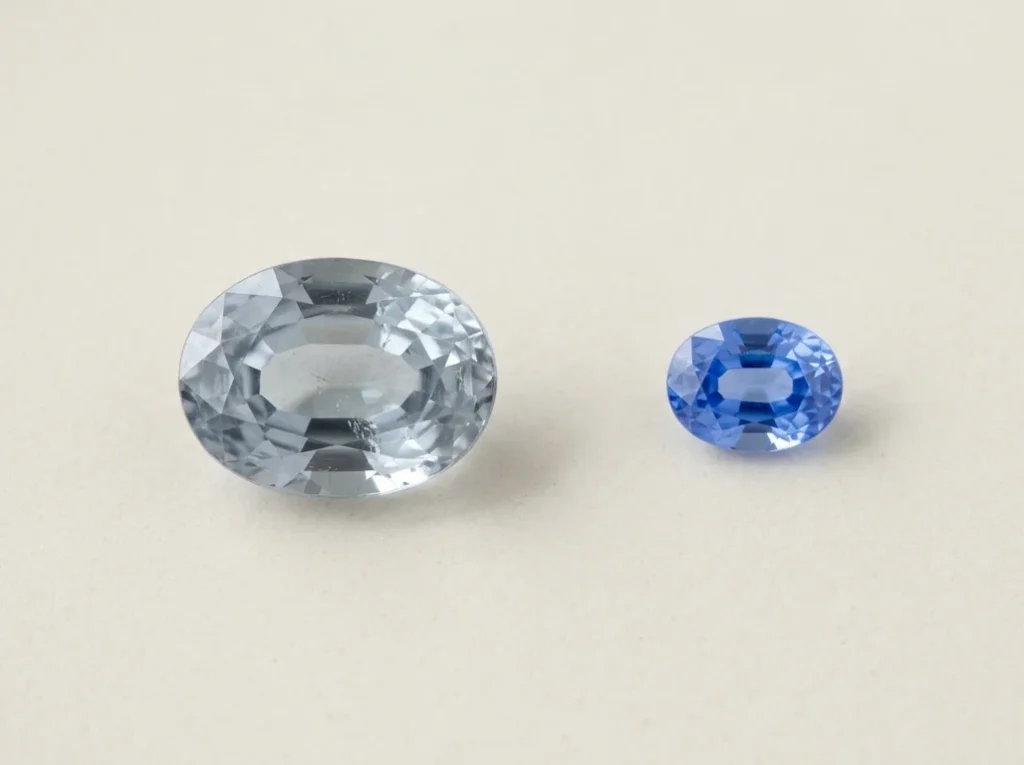
A 1 carat round sapphire faces up at roughly 6.0 mm, where a 1 carat round diamond faces up at roughly 6.5 mm: sapphire is the denser stone, so weight for weight it looks a little smaller. Settings are specified in millimetres while stones are priced in carats, and the millimetres are what the eye actually sees.
Cut depth varies stone by stone, so treat any conversion as approximate. Every listing here states the stone's own measured dimensions beside its carat weight, which is the honest answer to how big a particular stone really is.
The trade-off
Bigger stone or better colour?
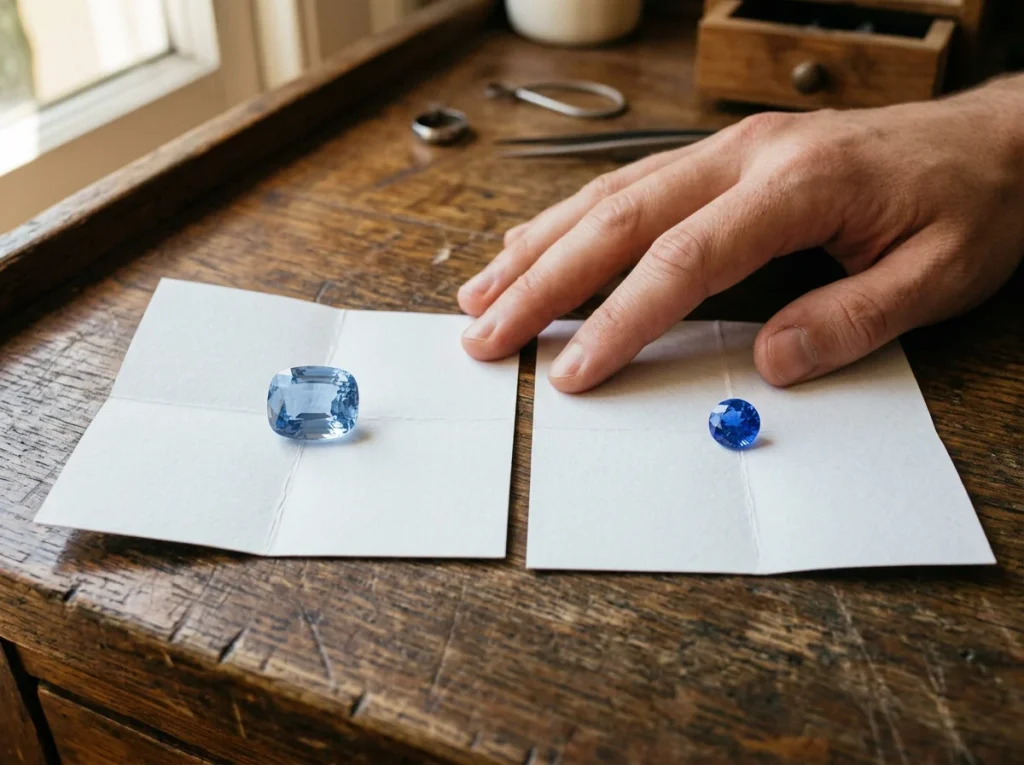
On a fixed budget the real choice is usually between a larger stone of quieter colour and a smaller stone of stronger colour, because colour moves a sapphire's price and its beauty more than weight does. Neither answer is wrong; they are different stones for different hands.
If you would rather see the choice than imagine it, tell us the hue, the size and the budget, and we search from there: one of each, side by side, under natural light.
Talk to a gemmologistThe hidden weight
Am I paying for weight I cannot see?
Sometimes. A stone cut deep carries weight in its belly that never shows face up, so two stones of the same carat can look quite different sizes from above. A shallower or spread-friendly cut faces up larger per carat.
The defence is the same as everywhere on this site: judge the stone by its measured dimensions and its photographs, not by the carat figure alone. Both are on every listing.
Keep reading
What does treatment do to the price?
Treatment splits the market again: an unheated stone typically asks a premium over a heated one of the same appearance, and the premium widens as the stones get bigger. The next page takes it apart; the general ranges by type sit on the index page.
Questions
Asked about weight and price
If a question about weight is not answered here, write to Colombo and a gemmologist replies, not a template.